Plinko Online in 2026: Mechanics, Math, Demo Modes, Real-Money Play and Responsible Use

Last updated: February 2026 · Written by: Reid Calloway, independent online-casino analyst, Vancouver · Reviewed by: the iGaming editorial desk (100+ documented demo sessions across Spribe, BGaming and in-house plinko builds, plus a read-through of regulator publications from the UK, Australia, Germany, Spain and Canada) · Audience notice: 18+, 19+ or 21+ depending on your jurisdiction.

Disclaimer. This guide is informational and educational. It is not legal, financial or medical advice. The legality of online gambling, including demo play, sweepstakes coins and bonus offers, varies by jurisdiction and can change without notice. Gambling involves the risk of losing money: both deposited funds and balances already credited to your account. If you recognise signs of problem gambling, contact a specialist support service in your country.

Provider

Spribe

RTP

97%

Volatility

High

Min bet

$0.10

Max bet

$100

Max win

555x
Plinko Online in 2026 Mechanics, Math

The short version, before anything else

  • What it is:plinko is a physics-style arcade gambling game. A ball drops from the top of a peg pyramid, gets deflected left or right at every peg, and lands in a bottom pocket carrying a payout multiplier applied to your stake. No reels, no paylines, no wilds, no scatters.
  • What you control:the bet size, the number of peg rows (commonly 8 to 16; Spribe's Plinko Classic uses 12, 14 or 16) and the risk level (Green/Low, Yellow/Medium, Red/High). You do not control the trajectory. Not even a little.
  • Headline numbers:Spribe's Plinko Classic is published at 97% theoretical RTP with a maximum win of 555× your bet, reachable only on 16 rows plus Red risk plus an outermost pocket. Several competing builds are advertised at 99% RTP. Confirm the figure inside the game's info panel before you stake.
  • The math:outcomes follow a binomial distribution. On the classic 13-row television board, path counts come from the 13th row of Pascal's Triangle, folded to account for side-wall bounces (78 / 221 / 495 / 792 / 924 / 792 / 495 / 221 / 78 out of 4,096 paths). Centre-drop expected value on the TV board is $2,555.32 per chip.
  • Demo first:free plinko is normally available in-browser with no download, no app and no deposit. Use it to test rows, risk tiers and autoplay. But treat demo results as marketing, not evidence: research links simulated gambling to monetary gambling harm.
  • Strategy reality check:no betting pattern (Martingale, pyramid, "predictor" bots) changes the expected value of an independent random draw. Progressions redistribute variance and raise ruin risk. They do not flip a negative expectation positive.
  • Practical protection:set deposit and loss limits before your first drop, verify the licence (iGaming Ontario/AGCO, MGA, Kahnawà:ke, Curaçao), check CAD support and Interac timelines if you are in Canada, and walk away from any app promising "guaranteed wins" or charging a fee to release a withdrawal.
The short version, before anything else

Why this matters if you are playing from Canada

Here is the part most plinko pages skip. The game itself is simple; the environment around it is not.

Online gambling in Canada is regulated province by province, not federally. In Ontario, the commercial market runs through iGaming Ontario under AGCO registration, and an operator's presence on that register is the single strongest trust signal you can check in under a minute. Outside Ontario, you are usually looking at a provincial lottery platform or an offshore brand holding a Kahnawà:ke, MGA or Curaçao licence. Those are not equivalent. A Malta or AGCO licence carries materially heavier player-protection duties than a generic Curaçao sub-licence.

Then there is money. If a plinko casino shows your balance in USD while your card and your Interac e-Transfer are in Canadian dollars, you are paying an invisible FX spread on every deposit and every cash-out. Ask two questions in live chat before you fund an account: is the wallet denominated in CAD, and how long does an Interac withdrawal take after approval, not before it?

Age matters too. Nineteen and up in most provinces, 18+ in Alberta, Manitoba and Quebec. Play outside your province's rules and you have no realistic route to a dispute if a payout stalls.

Why put this before the mechanics? Because the mechanics of plinko take four minutes to learn, and the licence, currency and withdrawal terms are what actually decide whether a win reaches your bank. That order of priority runs through this whole guide.

Why this matters if you are

1. Evidence Base, Methods, and Scope

In two sentences: this guide combines product-level documentation of plinko (rows, risk tiers, multipliers, provably fair systems) with peer-reviewed evidence on online gambling behaviour and regulator publications. Where a claim cannot be sourced, it is labelled as unverified rather than presented as fact.

1.1 Framing plinko within the online gambling research literature

Plinko sits in an awkward evidentiary position. It is a modern, high-turnover online product with almost no dedicated academic literature of its own, while the products it structurally resembles (electronic gambling machines, crash games, fast-cycle instant games) have been studied extensively. So much of what we can responsibly say about plinko is extrapolated from adjacent research. This guide flags the limits of that extrapolation: findings about slot volatility, inducements or deposit limits were not generated on plinko boards specifically.

«Multimodal approaches are necessary, because no single tool, pre-commitment, self-exclusion or pop-ups, is sufficient on its own.» Marionneau, Ruohio & Karlsson, narrative review (2023). https://pubmed.ncbi.nlm.nih.gov/

The practical consequence for a plinko player is simple. A single safeguard ("I'll just use the demo first", or "I'll only play with a bonus") is not a protection strategy. Layered controls are.

1.2 Search strategy and inclusion criteria

For this guide we prioritised three things: peer-reviewed studies published from 2022 onward on online gambling behaviour, inducements, simulated gambling and limit-setting; regulator and statutory sources, including comparative reviews based on regulatory texts from 27 countries; and provider-published game specifications, verified against in-game information panels wherever we could open them.

«18 countries permit deposit limits and 11 impose mandatory limits, out of 27 European jurisdictions reviewed.» Ruohio et al., comparative policy review (2024). https://link.springer.com/

Where competitor sources conflicted with the underlying data, and in at least one high-profile case they did, as documented in Section 3.4, we recalculated from first principles and reported the corrected figure. That correction is small in dollars and large in what it says about copy-paste sourcing.

Editor's note. Want to try plinko without risking cash? A no-deposit demo lets you study the board, test all three risk tiers and confirm the published RTP before your first real stake, on a licensed platform with responsible-gambling tools already in the account menu. → Try a plinko demo

Where competitor sources conflicted with the

2. Plinko Game Mechanics: Board, Ball, Rows, Risk Levels and Multipliers

In two sentences: every plinko round is a sequence of binary left/right deflections that ends in a fixed pocket with a preset multiplier. You configure the board's shape and volatility before the drop; after release, nothing you do influences the result.

2.1 The plinko board, ball and multipliers

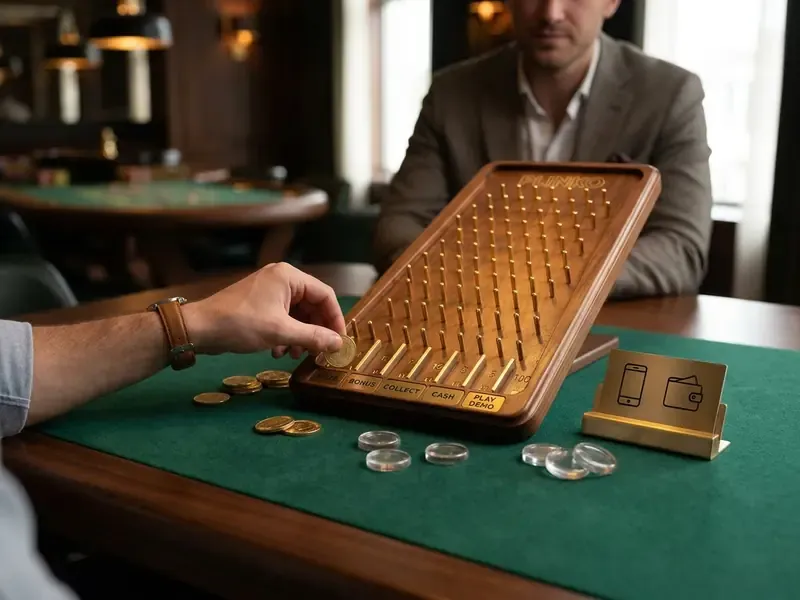
The board is a triangular lattice of pegs. A ball is released from a launch point at the apex; in most online builds the drop point is fixed and centred, while the original television board offered nine possible drop slots. At each peg the ball is deflected one step left or right. After n rows it arrives at one of n+1 landing pockets, each labelled with a multiplier applied directly to your stake.

Three structural consequences follow.

  1. Central pockets are the statistical default. More paths lead to the middle than to the edges, so low multipliers hit most often.
  2. Edge pockets are rare by construction. The largest multipliers sit in positions reachable by the fewest paths.
  3. The pockets are symmetric in probability, not necessarily in reward design. Online implementations sometimes depart from pure binomial symmetry by tuning multiplier values across pockets to hit a target RTP. Note: we found no peer-reviewed 2023+ source documenting probability manipulation in commercial plinko builds. Treat any claim of asymmetric probability weighting as unverified, and read the game's own paytable and fairness documentation.

The bouncing animation, the audible "plink" of each deflection, the near-miss when a ball settles one pocket away from a 555× cell: none of that is neutral presentation. In adjacent product categories these features are associated with heightened arousal and illusions of control, both well documented in studies of electronic gambling machines and sports betting products.

2.1 The plinko board, ball and

«Easier access, advertising and new bet types contributed to impulsive gambling and loss-chasing among people in treatment.» Hing et al., qualitative study of high-risk online gamblers (2022). https://www.wiley.com/

Two honest caveats. First, that evidence is not plinko-specific. Second, the near-miss literature on plinko boards in particular is still thin, so the mechanism is plausible and analogous rather than directly demonstrated.

2.2 Rows, pegs and risk levels

Unlike a standard slot, plinko hands you volatility before every drop. Using Spribe's Plinko Classic as the reference build:

  • Row count (12, 14 or 16).Twelve rows narrow the pyramid and concentrate outcomes near the centre: frequent but small returns. Sixteen rows widen the base and raise the ceiling in the outer pockets, while making those pockets harder to reach.
  • Three-tier colour risk system.Instead of one "play" button, the game gives you three coloured buttons, and the ball takes the colour you press:
  • Green (Low risk):minimum volatility. Centre pays roughly 0.5x to 1x; edges reach about 18x to 35x.
  • Yellow (Medium risk):balanced. Centre drops slightly below stake; mid to outer pockets reach roughly 55x to 118x.
  • Red (High risk):maximum volatility. Centre can return as little as 0.2x, but the outermost pockets on a 16-row board pay the game's top prize of 555x.
2.2 Rows, pegs and risk levels

How to reach the 555x ceiling: set the board to 16 peg rows, drop a Red ball, and land in the extreme left or right outer pocket. There is no bonus buy, no free-spin trigger and no gamble feature. The ceiling is reached only by landing the rarest pocket on the board.

Rows, risk and multiplier reference (Spribe Plinko Classic)

RowsRisk (colour)Typical centre returnApprox. outer-pocket ceilingPractical profile
12Green (Low)0.5x to 1x~18x to 35x (lower end of band)Longest sessions, smallest swings
12Yellow (Medium)~0.4x to 0.9x~55xBalanced, moderate swings
12Red (High)~0.2x to 0.3xHigh, below the 16-row ceilingVolatile, shorter runway
14Green (Low)0.5x to 1x~25x to 35xFrequent small returns
14Yellow (Medium)~0.4x to 0.9x~80x to 118xThe "sweet spot" many players prefer
14Red (High)~0.2xLarge, below 555xLong dry spells, sharp spikes
16Green (Low)0.5x to 1x~35xLow variance, wide board
16Yellow (Medium)~0.4x to 0.9x~118xBalanced with a higher ceiling
16Red (High)~0.2x555x (maximum win)Maximum volatility; the top prize is the rarest outcome

Ranges are indicative of Spribe's published Plinko Classic paytable and can differ between operator builds and game versions. Open the in-game paytable and confirm the exact multiplier grid for the specific rows and risk combination you intend to play.

2.3 Board layout and win distribution

Changing the risk tier does not change the physics. It changes the payout distribution. Green flattens it, so many outcomes cluster around break-even. Red stretches it: the modal outcome becomes a small loss, while a very rare outcome becomes the win you tell people about. Adding rows adds pockets, which spreads probability mass more thinly and lowers the chance of hitting any one specific band.

That matters behaviourally, not just mathematically. High-volatility games can encourage chasing, because long strings of small losses create the subjective sense that a correction is "due". That is the gambler's fallacy applied to a process with no memory.

2.3 Board layout and win distribution

«Online gambling innovations, including new bet types, disproportionately affected higher-risk gamblers.» Marionneau, Ruohio & Karlsson, narrative review (2023). https://pubmed.ncbi.nlm.nih.gov/

One small observation from testing. On Red 16, my own demo sessions regularly ran 60 or 70 drops without a single pocket above 10x, then produced two big ones back to back. The paytable never lied. My expectations did.

2.4 How plinko differs from slot machines and games like plinko

DimensionPlinkoVideo slotsCrash gamesMines
Core randomiserSequence of binary deflections, binomial outcomeWeighted reel strips / RNG symbol drawSingle RNG-generated multiplier curveRNG-placed hazards on a grid
Player control before the roundBet, rows, risk tierBet, sometimes lines or bonus buyBet, auto-cashout targetBet, number of mines
Player control during the roundNoneNoneCash-out timing (a real decision)Continue or stop at each tile
Volatility controlExplicit and granular (rows plus 3 tiers)Implicit, fixed by the gameImplicit, set by cash-out targetExplicit (mine count)
Feature layerNone (no wilds, scatters, free spins)ExtensiveMinimalMinimal
Round lengthVery shortShortVery shortVariable
TransparencyOften provably fair, verifiable per roundRNG certified by lab, not verifiable per roundOften provably fairOften provably fair

Two honest observations. First, plinko's absence of a feature layer is both its charm and its limitation: nothing is hidden, but nothing is anticipated either. Second, plinko rounds are fast, and the interface quietly invites repeat plays with adjustable stakes and risk tiers. We found no empirical study measuring plinko round duration specifically; that observation reflects hands-on testing and product design, and should be read as descriptive rather than measured.

3. Provably Fair Verification, RNG and the Mathematics of Plinko

In two sentences: provably fair systems let you verify, after the fact, that a specific ball drop was not manipulated. The underlying distribution is binomial, which means the whole game can be reconstructed from Pascal's Triangle.

3.1 The provably fair chain, step by step

How to check it yourself:

  1. Before playing, copy the hashed server seed shown in the fairness panel.
  2. Set or note your client seed and the current nonce.
  3. After the round, or after rotating the seed, the operator reveals the unhashed server seed.
  4. Hash the revealed seed with SHA-256 and confirm it matches the hash published in step 1.
  5. Recompute the deflection sequence with any public verifier and confirm the pocket matches what you saw.

If any of those five artefacts is missing (no pre-published hash, no client seed, no seed rotation, no verifier), the game is not provably fair, whatever the marketing page says.

3.1 The provably fair chain, step

3.2 RNG independence: why "hot" and "cold" boards do not exist

Each round is generated from a fresh input, a new nonce or a rotated seed pair. The probability distribution of round n+1 is unaffected by rounds 1 to n. Ten centre-pocket landings in a row do not raise the chance of an edge hit on the eleventh drop; they are simply a likely sequence in a distribution whose mode is the centre. This independence is the mathematical reason every "pattern reader" and "predictor" product is either useless or fraudulent.

3.3 Probability theory: Pascal's Triangle and the folded board

The academic reference case is the original The Price Is Right board, real plinko in physical form: nine drop slots at the top, thirteen rows of staggered pegs, nine prize chambers at the bottom. Because each peg contact is a binary event, the number of paths to each bottom position comes from the 13th row of Pascal's Triangle:

1  12  66  220  495  792  924  792  495  220  66  12  1     (4,096 total paths)

But the board is taller than it is wide: 13 rows against 9 columns. Chips that would exit the pyramid bounce off the side walls and re-enter. Mathematically that is a fold of Pascal's Triangle. Fold the outer tail back onto the body, so the 12 lands on the 66 and the 1 lands on the 220, then mirror it on the right. The result is the folded distribution for a centre drop:

3.3 Probability theory Pascal's Triangle and
ChamberA′B′C′D′E′ (centre)F′G′H′I′
Paths7822149579292479249522178
Probability0.0190.0540.1210.1930.2260.1930.1210.0540.019
TV prize$100$500$1,000$0$10,000$0$1,000$500$100

Path counts sum to 4,096, which is 2¹². Dropping from a different top slot simply moves the fold lines, redistributing the same triangle asymmetrically. Which is precisely why the studio audience shouting "centre!" was, for once, mathematically correct.

3.4 Expected value, plus a fact-check correction

With the centre drop and a $10,000 centre chamber:

EV = 2 × (0.019 × $100 + 0.054 × $500 + 0.121 × $1,000 + 0.193 × $0) + 0.226 × $10,000 ≈ $2,555.32 per chip

  • Five chips, all dropped from the centre: 5 × $2,555.32 = $12,766.60, against an announced "chance to win up to $50,000".
  • In the real format, a contestant receives one chip and can win four more by pricing four items, each with roughly a 0.5 success probability: $2,555.32 + 4 × 0.5 × $2,555.32 = $7,665.97 expected giveaway per playthrough.

Fact-check note (updated 2026). Some published summaries of this analysis label chambers D′ and F′ as "$10" prizes and describe the chamber values as "multipliers" (for example "100x"). Both are wrong. Recomputing with $10 in D′ and F′ yields roughly $2,563.66, not $2,555.32; only $0 in those chambers reproduces the widely quoted figure exactly. And on the television board these are fixed cash prizes, not stake multipliers. Multipliers belong to the online casino version, where the ceiling is a multiple of your bet, 555x for instance, not a dollar amount.

Historical context, kept in proportion: plinko debuted on 3 January 1983. Reporting associated with the game notes that no contestant has landed all five chips in the centre chamber, that only ten physical chips exist and are locked away between uses, and that the chips were engineered to produce the signature "plink". The largest reported plinko win at the time of the academic analysis was $39,200. Records like this change; verify against current broadcaster sources before republishing.

3.5 Monte Carlo simulation: how the board is modelled in code

The academic model behind those figures also ran RNG simulations, both to confirm the analytic distribution and to test non-standard board dimensions. The rule set is instructive, because it shows exactly how a staggered lattice gets encoded.

Odd-length rows (chip currently in column n):

  1. If the chip is in the rightmost position, it can only move to column n in the next row.
  2. If the chip is in the leftmost position, it can only move to column n−1.
  3. Otherwise it moves to n−1 if the RNG output is 50 to 99, or to n if the output is 0 to 49.

Even-length rows:

  1. RNG 0 to 49: move left, to column n of the next row.
  2. RNG 50 to 99: move right, to column n+1.

Ignoring the final column on even rows is what produces that offset, staggered geometry. Data collection ran 1,000 chip drops per board configuration, repeated five times, before board dimensions were altered, a design that shows both the mean distribution and the sampling noise around it. The practical lesson for players is blunt: even 5,000 simulated drops on a fixed configuration wobble visibly around the theoretical curve. Your fifty-drop session tells you nothing about RTP.

3.5 Monte Carlo simulation how the

4. Plinko Demo and Free Modes: Trying the Game Without Risk

In two sentences: a plinko demo is normally available instantly in a browser with no download, no app and no deposit, and it is genuinely useful for learning the controls. It is also a marketing funnel, and research links free-play exposure to greater monetary gambling harm.

4.1 What a plinko demo lets you test

Free plinko lets you verify, at zero financial risk:

  • Row count behaviour. How 12 versus 14 versus 16 rows changes the spread of landings.
  • Risk tiers. How Green, Yellow and Red reshape the payout distribution.
  • Autoplay. How many rounds run, and which stop conditions (stop on win, stop on loss, loss limit) actually exist.
  • The paytable. The exact multiplier grid for each configuration.
  • The fairness panel. Whether seeds and hashes are exposed at all.
  • Performance. Frame rate and input latency on your specific device.
  • Session pacing. How many rounds you complete in ten minutes, which is a direct proxy for real-money turnover.

That is the upside. The evidence on the downside is uncomfortable.

4.1 What a plinko demo lets

«49.9% of participants had played free social casino games and 32.7% demo games; both were associated with higher PGSI scores.» Hing et al., observational study, Australia (2024). https://www.wiley.com/

«Exposure to an inflated demo mode led to significantly higher stakes in subsequent real-money play among participants aged 18 to 24.» Kim et al., randomised experiment, 128 participants (pre-2023, outside the primary evidence window). https://pubmed.ncbi.nlm.nih.gov/

In that experiment, time spent playing did not differ between groups. Only the money did. The mechanism is straightforward: a free-play build that pays more generously than its real-money twin teaches you an expectation the cashier will not honour. Assume nothing about real-money RTP from a demo unless the operator publishes the same certified figure for both.

4.2 Do you need a download, an app or a deposit for the demo?

Usually none of the three. In practice, plinko demos are browser-based games that load on mobile or desktop without installing anything. Operators use demo modes as part of user-acquisition funnels, which is why the demo sits one click from a registration prompt. If you want a straightforward starting point, look for casinos offering a plinko demo mode that expose the paytable and the fairness panel before you create an account.

Two regulator datapoints put the scale of browser-based gambling in context.

«Online gross gambling yield in Great Britain was £6.5 billion in 2022 to 2023, with around 19.6 million adults gambling online.» Gambling Commission, Annual Report 2023–24. https://www.gamblingcommission.gov.uk/

«Between October and December 2023, the ACMA completed 20 investigations covering 40 websites and found 57 breaches of the Interactive Gambling Act 2001.» Australian Communications and Media Authority (2023–24). https://www.acma.gov.au/

The ACMA figures included a breach for advertising a prohibited or unlicensed regulated interactive gambling service in Australia. So "there's a free plinko demo, therefore it must be fine here" is not a legality test. Availability in your browser says nothing about whether the operator is licensed to serve your province or country.

4.3 Demo checklist before your first real stake

  • I have opened the paytable and written down the multiplier grid for the configuration I intend to play.
  • I have confirmed the published RTP in the in-game info panel, not just on the landing page.
  • I have tested all three risk tiers for at least 50 drops each and seen the dry spells.
  • I have found the autoplay stop-loss and confirmed it works.
  • I have located the fairness and seed panel and verified one round end to end.
  • I have located deposit-limit, session-timer and self-exclusion tools in the account menu, before depositing.
  • I know whether the demo RTP and the real-money RTP are stated to be identical.
4.3 Demo checklist before your first

5. Plinko Real Money: Casinos, Offers, Bonuses and Regulatory Context

Legal and ethical disclaimer. This information is general and does not replace professional legal or financial advice. The legality of online gambling varies by jurisdiction; age thresholds may be 18+, 19+ or 21+ depending on where you are; and bonus availability is frequently restricted by state, province or country. Verify eligibility before you deposit.

In two sentences: the commercial layer around plinko, bonuses, free coins, rakeback, promo codes, measurably changes betting behaviour, usually not in the player's favour. Evaluating an operator therefore means reading licence, wagering and withdrawal terms, not comparing headline coin totals.

5.1 How to assess a casino, its bonuses and its offers

Experimental research on wagering inducements is among the most policy-relevant work in this field, and the effect sizes are not subtle.

«Inducements reduced the likelihood of declining a bet by 44% and tripled the proportion of participants placing objectively unfavourable bets.» Experimental inducement study, Euro 2024 (2025). https://link.springer.com/

In the same body of work, inducement exposure was associated with an 11% increase in spending. The demographic pattern matters too.

«Younger respondents rated bonus and sign-up offers as the most influential in increasing their betting and choosing higher-risk strategies.» Study of youth perceptions of sports betting promotions (2023). https://pubmed.ncbi.nlm.nih.gov/

Bonuses persuade because the upfront cost feels lower. The money at risk feels like someone else's. So a responsible evaluation of plinko offers has to go past surface features such as RTP and volatility. Compare online casinos with plinko on licence, wagering contribution, withdrawal caps and limit tooling first, then compare coin bundles.

Here is the reviewer's version of that, in the order I actually check things: licence number in the public register, then withdrawal method and stated timeline, then the bonus wagering multiplier and plinko's contribution rate, then whether deposit limits sit two taps from the lobby. Coin totals come last. They are the loudest number on the page and the least informative.

Editor's note. Choosing where to play plinko for real stakes? Look for transparent bonus terms, an explicit wagering requirement and deposit limits you can set before your first round, which is exactly what responsible-gambling research recommends. → Review the bonus terms

Bonuses persuade because the upfront cost

5.2 US sweepstakes platforms for plinko (dual-currency model)

Because real-money online casinos are restricted in most US states, plinko is widely distributed through sweepstakes, or dual-currency, casinos. Two currencies run in parallel:

  • Gold Coins (GC). Purely for entertainment. No redemption value, ever.
  • Sweeps Coins (SC), Stake Cash, Fliff Cash. Promotional entries obtained free, or bundled with a GC purchase, that can be redeemed for cash prizes after a playthrough requirement.
CasinoHeadline no-purchase offerPromo codePlinko variantsPlaythrough
Stake.us260K GC + 55 Stake Cash + 5% rakebackDEADSPINExclusive in-house Plinko Original3x
Sidepot.us10,000 GC + 1 Fliff CashNot requiredXY Plinko, Plinko, Plinko 2 Multiplier Madness1x
Real Prize100,000 GC + 2 SCNot requiredEaster Plinko, Pine of Plinko1x
Jackpota7,500 GC + 2.5 SCNot requiredPlinko, Xmas Plinko (Gaming Corps)1x
McLuck7,500 GC + 2.5 SCDEADSPINPlinko-themed titles1x

Offer values, codes and state availability change frequently and are promotional in nature; several of these brands also run rotating "first purchase" packages with different terms. Verify the current offer, the playthrough multiplier and the state-restriction list on the operator's own terms page before registering. Codes attributed to third-party media partners may not be honoured outside those partnerships, a point that needs independent verification at the time of reading.

How to read a sweepstakes offer properly:

  1. Separate GC from SC. Only SC has redemption potential.
  2. Find the playthrough multiplier on SC. A 1x and a 3x obligation are not close.
  3. Check the game contribution for plinko and arcade titles. Instant and arcade games often contribute far less than slots, sometimes 0% to 10%.
  4. Check the maximum bet allowed while a bonus is active.
  5. Check minimum redemption and KYC requirements before you win, not after.
Offer values, codes and state availability

5.3 Canada: licensing, CAD and Interac in practice

Canadian players face a different structure again. The checkpoints:

  • Ontario. The regulated market is licensed by the AGCO and operated commercially through iGaming Ontario. If you are in Ontario, an operator's presence on the iGO register is the strongest single signal.
  • Other provinces. Provincial lottery corporations run their own platforms, while many offshore operators serve Canadians under Kahnawà:ke Gaming Commission, MGA (Malta) or Curaçao licences. Licence quality varies widely. MGA and AGCO impose materially more player-protection obligations than a generic Curaçao sub-licence.
  • Currency. Confirm that balances, bet sizes and payouts are shown in Canadian dollars. Playing in USD adds an invisible FX spread to every deposit and withdrawal.
  • Payments. Interac e-Transfer and Interac Online are the standard Canadian rails, alongside e-wallets and cards. Ask support, in writing, for four numbers: pending period, processing time after approval, per-transaction and monthly limits, and any fee.
  • Age. 19+ in most provinces, 18+ in Alberta, Manitoba and Quebec.
5.3 Canada licensing, CAD and Interac

5.4 Real money, cash and getting a win out

Before depositing, make sure you are legally eligible and using licensed casinos offering plinko in your jurisdiction. The regulatory picture is genuinely divergent.

  • Germany. The Interstate Gambling Treaty provides a centralised system across licensed providers, maintaining a cross-provider monthly deposit limit of €1,000.

«Spain requires customers to set time and deposit limits before starting casino play; Slovenia and Slovakia require limit-setting at each login.» Ruohio et al., comparative policy review (2024). https://link.springer.com/

  • United Kingdom. Licensed operators must offer deposit limits and account controls under remote technical standards, alongside GAMSTOP self-exclusion.
  • Australia. Online casino games including plinko are prohibited under the Interactive Gambling Act 2001, and the ACMA actively enforces against offshore operators and their advertising.

KYC and withdrawal checklist

StageWhat to doWhy it matters
Before depositConfirm the licence number in the regulator's public registerA licence logo is not a licence
Before depositRead withdrawal limits per method and per monthCaps can strand a large plinko win
Before depositSet deposit and loss limitsPre-commitment works best before the first loss
At registrationComplete KYC (ID, proof of address, payment ownership) earlyVerification is the most common cause of stalled payouts
While playingKeep play on one device and one accountMulti-account and sync issues trigger security holds
At withdrawalScreenshot the cashier terms and request timelines in writingWritten support answers are your evidence in a dispute
NeverPay a "release fee", "tax" or "unlock fee" to receive winningsThis is a defining marker of fraud

E-E-A-T disclaimer. Availability of real-money play, bonuses and cash-out methods depends on your country and province, local rules and the terms of the specific casino. Participation is restricted to adults only: 19+ in most Canadian provinces, 18+ in Alberta, Manitoba and Quebec.

6. Rows, Risk Levels, RTP and Volatility

In two sentences: RTP is a long-run average, volatility describes the shape of the distribution around it, and the maximum multiplier only defines the ceiling. None of the three tells you what will happen in your session.

6.1 What RTP actually is

A 97% RTP means the game is designed to return, on average, 97 units for every 100 staked across a very large number of rounds, typically millions, not hundreds. The complement, the house edge, is 3%. A 99% RTP build has a 1% edge. Both figures are theoretical, calculated over the full distribution.

Three things players routinely get wrong.

  1. RTP is not a session promise. Variance is large and short samples do not converge. Losing your whole bankroll on a 99% RTP game is a completely ordinary outcome.
  2. RTP does not change with risk tier. In a well-designed plinko, Green and Red are engineered to the same RTP; they differ in variance, not expected return. Verify it in the paytable. Some builds publish per-tier RTP figures, and if those diverge you should know by how much.
  3. RTP does not accumulate a debt. Nothing "owes" you the missing 3%.
6.1 What RTP actually is. A

6.2 Volatility and the shape of the distribution

Volatility is variance. On Green/Low the outcome distribution is tight: most drops return something close to your stake and the bankroll drifts slowly. On Red/High with 16 rows the distribution is extreme: the modal outcome is a large fractional loss, those 0.2x returns, offset by a very rare 555x. Same RTP, radically different lived experience, and radically different risk of ruin at a given stake size.

Rule of thumb worth taping to your screen: the higher the volatility, the smaller your unit stake must be to survive long enough for the distribution to express itself. Play Red on 16 rows at 5% of bankroll per drop and the mathematics of ruin, not the paytable, decides your session.

6.2 Volatility and the shape of

6.3 Maximum win multipliers: what they do and do not mean

The maximum multiplier defines the upper bound of the outcome set. Updated formulation: a higher ceiling does not by itself imply a worse or better house edge, because operators balance RTP by adjusting the probabilities and the values of the remaining pockets at the same time. That is a design relationship, though, not a law, and the only way to know how a given board is balanced is to read its full paytable. Treat "555x max win" as a statement about the tail of the distribution, not about generosity.

Fact check. RTP and multipliers do not guarantee an individual win. A published 97% figure describes millions of rounds in aggregate, not your next ten drops. And a run of results in one direction is not a forecast: each drop is independent, so past pockets carry zero predictive information about the next one.

6.4 Personalisation: the variable most players never see

There is now direct evidence that operators tune the commercial layer around games like plinko using behavioural data.

«Regression analysis of operator data showed bonuses reduce stake size by roughly 49%, while positive profit information amplifies it.» Study of AI personalisation in online gambling (2025). https://link.springer.com/

Read that twice, because it is counter-intuitive. Bonuses in that dataset were associated with smaller stakes per round, while messaging about profit significantly amplified stake size. Either way the practical point holds: what you are shown, and when, influences how you bet, independently of RTP and volatility. Your stake sizing should come from a written plan, not from the interface.

7. Plinko Strategy: Managing Your Bet and Your Risk

Disclaimer. This information is general and does not replace consultation with a problem-gambling specialist. If you notice signs of dependency, contact a dedicated support service in your country.

In two sentences: there is no plinko strategy that changes expected value; the only genuine decisions are stake size, configuration and when to stop. Everything else marketed as strategy is either variance management dressed up as an edge, or outright fraud.

7.1 Why Martingale and progressions fail, with the proof

Let X be the net result of one drop. Since the game has a house edge, E[X] < 0. Now take any staking plan that scales the bet: doubling after a loss (Martingale), pyramid progressions, "reverse" systems, session-based ratcheting. By the linearity of expectation, the expected result of a sequence of bets is the sum of the individual expectations, each negative and each scaling with the stake:

E[Σ aᵢXᵢ] = Σ aᵢE[Xᵢ] < 0 for any positive stake multipliers aᵢ.

No sequencing rule changes the sign. What progressions do change is the distribution of losses: they convert many small losses into a high probability of small wins plus a small probability of a catastrophic one. Martingale only "works" under two conditions that never hold in practice, an unlimited bankroll and no table maximum. With either constraint in place, the probability of ruin climbs fast while expected value stays negative.

Three related myths worth naming:

  • "Alternating tiers" (Green, Green, Red). Independent rounds. No effect.
  • "Cold board detection." There is no memory to detect.
  • "Predictor" software and plinko bots. In a provably fair game the outcome is determined by a server seed you cannot see until it is revealed and cannot influence at all. Any product claiming to predict the landing pocket is claiming to break HMAC-SHA256. Treat it as malware, credential theft, or an affiliate scam.
7.1 Why Martingale and progressions fail

7.2 What actually counts as a decision

  • Unit stake as a fraction of bankroll. The single most consequential choice you make.
  • Risk tier matched to bankroll and session length. Red on 16 rows with a small bankroll is a short story.
  • A hard stop-loss and a hard stop-win, set in the account tools, not in your head.
  • Session duration, capped by a timer.
  • Withdrawing. Moving winnings out is the only action that turns a balance into money.

7.3 Limits on bets and deposits: pre-commitment in practice

Recent work has tried to identify empirical thresholds separating lower-risk from higher-risk online gambling. Depositing more than four times a month, depositing more than 2% of pre-tax household income a month, and holding more than two active wagering accounts all emerge as predictors of harm.

«ROC analysis identified depositing more than four times per month and more than 2% of household income as key predictors of harm on the PGSI.» Study of lower-risk thresholds for online betting (2025). https://pubmed.ncbi.nlm.nih.gov/

The design of the limit matters as much as the number.

«Voluntary, removable deposit limits did not reduce net losses compared with the control group at a Finnish state operator.» Auer et al., randomised controlled trial (pre-2023, outside the primary evidence window). https://pubmed.ncbi.nlm.nih.gov/

That trial concluded voluntary, removable limits of optional size did not affect subsequent gambling intensity. Combine it with the comparative policy evidence, mandatory limits in 11 of 27 European jurisdictions, mandatory limit-setting at login in Slovenia and Slovakia, a cross-provider €1,000 monthly cap in Germany, and the implication is clear: limits work best when they are hard to remove and applied before play begins, not when they are cosmetic toggles buried in a settings menu.

7.4 Choosing an operator that actually watches for harm

When you compare brands, ask whether the operator monitors behaviour proactively and reaches out when risky patterns appear, instead of waiting for the player to self-report.

«Operator document analysis found deposit thresholds, for example SEK 10,000 per month, trigger escalation protocols and customer contact.» Mixed-methods study of operator duty-of-care documentation (2025). https://link.springer.com/

Support quality is part of the same signal. If live chat cannot tell you the Interac processing window in plain sentences, it probably cannot tell you much about your account either.

7.5 Pre-session responsible-play checklist for plinko

  • Bankroll defined and separated from bills, rent and savings, treated as entertainment spend.
  • Unit stake at or below 1% of session bankroll for Red/High risk; at or below 2% for Green/Low.
  • Deposit limit set in the account tools before the first drop, daily and monthly.
  • Loss limit and win target written down. A number for both, decided in advance.
  • Session timer set, say 30 minutes, with an alarm outside the app.
  • Risk tier chosen deliberately, matched to bankroll and remaining time.
  • Autoplay stop conditions configured, or autoplay left off entirely.
  • KYC already completed, so a win can actually be withdrawn.
  • No play while tired, drinking, or chasing an earlier loss.
  • End-of-session ritual: review history, confirm limits are still active, then decide about tomorrow, not now.
- Bankroll defined and separated from

8. Plinko Mobile, Apps and Download

In two sentences: most plinko is played in a mobile browser, with native apps and installable web apps as alternatives. The install path is also the most common attack surface for fraud, so verification before the tap matters more than convenience.

8.1 When the browser version of plinko online is enough

Updated formulation: in the builds we tested, plinko is typically delivered as a browser-based HTML5 game that runs on desktop and mobile without a software install. Delivery does vary by operator and jurisdiction, and some brands distribute native Android packages or App Store listings instead. Treat "no download required" as something to confirm on the operator's own page rather than a universal property of the game.

For most players, honestly, the browser is the answer. It updates itself, it collects less about you, and it cannot be side-loaded from a fake source. The trade-offs:

Mobile browserNative app (Android/iOS)Installable web app (PWA)
Install frictionNoneHighestLow (add to home screen)
Update modelAutomatic on reloadStore or in-app updatesAutomatic on reload
PerformanceGood on modern devicesUsually bestClose to browser
Push notificationsLimitedFullPartial
Data collectedModerateHighest (device, sensors, usage)Moderate
Fraud risk at installLowHighest (side-loaded APKs)Low
Availability for gamblingBroadRestricted by store policy in many regionsBroad

The data column is not a footnote. Native plinko apps generate the richest behavioural dataset, with possible implications for harm:

«Operators use behavioural data to tailor bonuses and profit signals, influencing stake size independently of RTP and volatility.» Study of AI personalisation in online gambling (2025). https://link.springer.com/

8.2 Installing a plinko app on Android (APK), step by step

  1. Open the official site of a verified operator. Check the URL character by character; typo-squatting is the most common vector.
  2. Download the .apk and, if the site publishes a checksum or signature such as SHA-256, verify the file matches. If no checksum is offered, that itself is a data point.
  3. Confirm the publisher name matches the brand and that the filename carries no extra characters.
  4. In your device's security settings, allow installation from that trusted source only, then revoke the permission afterwards.
  5. Make sure the OS is current and there is enough free space so the installer does not fail midway.
  6. Run the installer. If it requests permissions unrelated to gameplay (contacts, SMS, call logs, accessibility services), stop and reassess the source.
  7. Launch, sign in, set deposit and loss limits, enable only the notifications you actually want, then play the demo before staking.
8.2 Installing a plinko app on

8.3 iPhone and iPad options

App Store policy restricts real-money gambling listings in many regions, so the standard route is a Progressive Web App. Open the operator's site in Safari, tap Share, then Add to Home Screen. Keep the default icon and name so you do not confuse it later with a look-alike. The result launches full-screen, keeps your preferences between sessions and updates whenever the page refreshes. Where a native listing does exist, it updates automatically through the App Store. Either way, keep iOS current and confirm you are dealing with the genuine brand.

8.4 What to check before you download a plinko app

Verified operators publish ownership, licence details, independent RNG testing information and data-handling policies in plain language, up front, not after you commit. Look for behavioural risk assessment, self-assessment tools and self-exclusion options, plus internal practices such as documentation and escalation protocols.

«Key duty-of-care elements include behavioural risk assessment, deposit and loss limits, session time restrictions and self-assessment tools.» Mixed-methods study of operator duty-of-care documentation (2025). https://link.springer.com/

A practical test I use on every review: can you reach responsible-gambling tools from the account menu in two taps? If it takes five, the design is telling you something about priorities.

8.5 Four markers of a plinko scam app

  1. Promises of "guaranteed income", "hacked algorithms" or "predictor" accuracy. Mathematically impossible in a provably fair game.
  2. No published fairness hashes, or no way to verify a single round independently.
  3. A demand for prepayment, whether it is called a fee, a tax, an "unlock" or a "verification deposit", before winnings are released.
  4. No responsible-gambling tools, or limits you cannot find in the account menu.

Secondary red flags: mismatched branding between site, app icon and in-app screens; aggressive pop-ups pushing an immediate deposit; fabricated testimonials; unexplained redirects; support that answers with vague scripts instead of specifics.

8.5 Four markers of a plinko

8.6 Mobile feature snapshot: what to check before you commit

FeatureWhy it mattersWhat to checkCanada note
Download sourceTrust starts at installOfficial site or store listing; correct publisher nameAvoid side-loads with renamed files
Fairness / RNGPredictable randomness would be a red flagIndependent testing; public audit or provably fair panelLook for plain-English summaries
RTP and volatilitySets expectationsClear ranges in the in-game helpTest in demo before staking
PaymentsDeposits and cash-outs are where problems surfaceMethods you already use; fees and limits shown upfrontConfirm balances and payouts in CAD; check Interac timelines
Support and RG toolsYou need help before you need helpLive chat hours, response times, RG toolingSelf-exclusion and limits visible in two taps
AccessibilityLong sessions on small screensLarger text, haptic cues, portrait layoutMis-taps cost money
Device stabilityPlinko is animation-heavyStable on mid-range phones, not just flagshipsLag hurts plinko more than slots

Editor's note. Ready to play plinko deliberately? Look for a platform with self-limitation tools, a full bet history and responsible-gambling support in line with European regulators' best practice. → Set your limits first

  1. Conclusion: Synthesis of Evidence and What It Means for Plinko Players

Plinko is unusually transparent for a gambling product. No hidden bonus logic, no weighted reel strip you cannot inspect, and in provably fair builds you can verify any individual round yourself. The mathematics is elementary enough to reconstruct on paper: a binomial distribution, a folded Pascal's Triangle, an expected value you can compute in one line.

That transparency is also the trap. Because the mechanism is legible, it feels controllable. It is not. You choose rows, risk tier and stake, and the outcome is then decided by a process wholly indifferent to your choices. The available evidence suggests this combination, visible mechanics plus granular volatility controls plus very fast rounds, is exactly the profile associated with elevated risk, especially when inducements are added.

9. Conclusion Synthesis of Evidence and

«Visual and interactive game elements shape illusions of control and distorted risk perception, especially when outcomes mimic player agency.» Marionneau, Ruohio & Karlsson, narrative review (2023). https://pubmed.ncbi.nlm.nih.gov/

The defensible summary for a 2026 player:

  • Learn in demo, discount demo results. Free-play engagement is empirically associated with higher PGSI scores, and inflated demo RTP has been shown to raise subsequent real-money stakes among 18 to 24-year-olds.
  • Read the paytable, not the headline. 97% versus 99% RTP matters far less than your unit stake relative to bankroll on a Red 16-row board.
  • Treat bonuses as behavioural interventions, not free money. Inducements cut bet-refusal likelihood by 44% and tripled unfavourable bets under experimental conditions.
  • Prefer hard, pre-set limits. Voluntary removable limits did not reduce net losses in a randomised trial, and mandatory pre-play limits are the direction regulators keep moving.
  • Verify the operator before the install, not after the withdrawal request. The licence register, the fairness panel and the two-tap RG menu are your three fastest checks.
  • No strategy beats linearity of expectation. If a product claims otherwise, it is selling you something other than plinko.

Plinko can be an entertaining, short-session game with genuinely interesting mathematics behind it. It is not an income source, and no configuration of rows and colours will turn it into one. Compare on the facts, read the terms before you deposit, and play responsibly. 19+ in most of Canada.

The defensible summary for a 2026

  1. FAQ: Plinko Questions Canadian Players Actually Ask

What is the RTP of Spribe's Plinko Classic?

The published theoretical Return to Player is 97%, above the roughly 96% typical of online video slots, which implies a 3% house edge over the very long run. It is a theoretical average across millions of rounds, not a session guarantee. Other builds, including some of the best plinko releases from BGaming, are advertised at up to 99%. Confirm the figure in the game's own info panel.

How do I actually play plinko?

Set your bet, choose the number of peg rows (12, 14 or 16 in Plinko Classic), then press one of three coloured buttons: Green for low risk, Yellow for medium, Red for high. A ball of that colour drops from the apex, bounces through the pegs and lands in a multiplier pocket. The multiplier applies to your stake immediately.

What is the maximum win on Plinko Classic?

555x your bet. It requires 16 peg rows, a Red ball and a landing in one of the outermost pockets, which is the rarest outcome on the board.

Is plinko provably fair?

Spribe's Plinko Classic and most crypto-era in-house builds use provably fair cryptography. A hashed server seed is published before the round, combined with your client seed and a nonce, then revealed afterwards so you can recompute the result. If a game offers no pre-published hash, no client seed and no verifier, it is not provably fair.

Can I play plinko for real money in the US?

Real-money online casinos are restricted in most US states, so plinko is generally offered through sweepstakes casinos using Gold Coins for entertainment play and Sweeps Coins redeemable for cash prizes after a playthrough requirement. Availability varies by state, so check the operator's restricted-state list.

Is plinko legal in Canada, and can I play in CAD?

Online gambling is regulated provincially. In Ontario, look for operators registered with the AGCO and iGaming Ontario. Elsewhere, provincial platforms and offshore operators licensed by Kahnawà:ke, MGA or Curaçao serve the market. Confirm balances and payouts are denominated in Canadian dollars, and check Interac e-Transfer processing times and limits before depositing. Minimum age is 19+ in most provinces, 18+ in Alberta, Manitoba and Quebec.

Does plinko count toward bonus wagering requirements?

Often only partially, sometimes not at all. Arcade and instant-win games frequently contribute 0% to 10% of the rate applied to slots, and many bonus terms also cap the maximum bet while a bonus is active. Read the specific game-contribution table in the T&Cs before assuming plinko will clear a wagering requirement.

Do plinko predictor bots or hacks work?

No. In a provably fair game the outcome derives from a server seed you cannot see until it is revealed and cannot influence at all. Products claiming prediction are claiming to break HMAC-SHA256; in practice they are malware, credential harvesters or affiliate scams. Independent tools that verify a completed round are legitimate. Tools that predict a future round are not.

Does the Martingale system work on plinko?

No. Each round has negative expected value and rounds are independent, so linearity of expectation guarantees any stake-scaling scheme keeps a negative expectation. Martingale also needs an unlimited bankroll and no bet cap; with either constraint present, the probability of ruin rises sharply.

Which is better, fewer rows or more rows?

Neither is better; they differ in variance. Twelve rows concentrate outcomes near the centre for steadier, smaller returns. Sixteen rows widen the board, thin out the probability of any single pocket, and lift the outer-pocket ceiling to 555x on Red. Match the choice to your bankroll and your intended session length.

Do risk levels change the RTP?

In well-designed implementations, no. Green, Yellow and Red are engineered to the same theoretical RTP and differ only in variance. Some builds publish per-tier figures, so open the paytable and check rather than assume.

How many rounds do I need for RTP to show up?

Far more than a human session. Academic simulations of plinko boards ran 1,000 drops per configuration, repeated five times, and still showed visible variance around the theoretical distribution. Fifty or five hundred drops tell you nothing about the underlying RTP.

What is the expected value of the television plinko board?

Dropping from the centre slot on the 13-row, 9-chamber board with a $10,000 centre chamber, expected value is $2,555.32 per chip. Five centre-dropped chips imply $12,766.60, and factoring in the roughly 0.5 probability of winning each of the four bonus chips gives an expected giveaway of $7,665.97 per playthrough.

Can I play plinko on my phone without installing anything?

Usually yes. Most implementations run as browser-based HTML5 games on iOS and Android. If you want an app-like experience without a native install, add the site to your home screen from Safari on iOS or Chrome on Android to create an installable web app.

How do I spot a fake plinko app?

Four decisive markers: guaranteed-win claims, no published fairness hashes, any prepayment demanded before withdrawal, and missing responsible-gambling tools. Add mismatched branding, pushy deposit pop-ups and evasive support answers as supporting evidence, then walk away.

What should I do if I think my play is becoming a problem?

Use the operator's self-exclusion and limit tools immediately, then contact a specialist service in your jurisdiction: a provincial or national problem-gambling helpline, or in Great Britain the multi-operator self-exclusion scheme. Evidence indicates layered measures work better than any single tool, so combine account-level limits, device-level blocking and human support.


11. Appendix

A. Plinko provider comparison (verify before staking)

Provider / buildRows offeredRisk tiersPublished max winProvably fairNotes
Spribe, Plinko Classic12, 14, 16Green / Yellow / Red555xYesPublished 97% RTP; no bonus features, no jackpot
BGaming, PlinkoConfigurable, commonly 8 to 16Low / Medium / HighHigh (verify)Yes in most integrationsFrequently listed at 99% RTP: confirm in the info panel
In-house "Originals", e.g. Stake.us8 to 16Low / Medium / HighHigh (verify)YesExclusive to the operator, not available elsewhere
Gaming Corps, Plinko / Xmas PlinkoVaries by titleVariesVariesVariesSeasonal variants common on sweepstakes platforms
Other variants (XY Plinko, Plinko 2 Multiplier Madness)VariesVariesVariesVariesFeature layers differ substantially from Plinko Classic

This table consolidates provider-published and operator-published figures. Several values could not be independently verified against a primary provider document and are marked accordingly. Always read the in-game paytable and RTP disclosure for the exact build you are playing.

B. Four checks before your first deposit

  1. Licence. Find the licence number and confirm its status in the regulator's public register (AGCO and iGO, MGA, Kahnawà:ke, Curaçao, UKGC).
  2. Wagering. Locate the exact turnover multiplier, plinko's game contribution, the max bet under bonus, and any withdrawal cap on bonus winnings.
  3. Payouts. Note the stated pending period, the processing time per method, and any per-transaction or monthly limit, in CAD if you are in Canada.
  4. Reliability. Review recent complaint volume, unresolved payment disputes, and whether user reports match the operator's published terms. Reviews reflect outcomes; T&Cs and registers reflect formal status. Read both.
B. Four checks before your first

C. Glossary

  • RTP (Return to Player):theoretical long-run percentage of stakes returned as wins.
  • House edge:100% minus RTP.
  • Volatility / variance:how widely results scatter around the average.
  • Multiplier:the factor applied to your stake by the landing pocket.
  • Rows / pegs:the height of the pyramid, which sets the number of landing pockets (rows plus one).
  • Risk level:the payout distribution preset (Green/Yellow/Red, or Low/Medium/High).
  • Provably fair:commit-reveal cryptography allowing per-round verification.
  • Server seed / client seed / nonce:the three inputs hashed to generate a round outcome.
  • GC (Gold Coins):entertainment-only sweepstakes currency with no redemption value.
  • SC (Sweeps Coins):promotional sweepstakes currency redeemable for prizes after playthrough.
  • Playthrough:the turnover multiple required before SC can be redeemed.
  • KYC:identity verification required before withdrawal.
  • PGSI:Problem Gambling Severity Index, a standard harm-screening instrument.
  • Pre-commitment:setting binding limits before play begins.
  • PWA:Progressive Web App, a website installable to the home screen.
C. Glossary

D. About this review

Reid Calloway is an editorial persona for our Canadian desk: an independent online-casino analyst voice based in Vancouver, focused on licensing, payments and responsible-gambling practice. Every brand mentioned here is assessed against one checklist, licence and regulator, real payout speed and limits, bonus fairness, game range, support quality and RG tooling, and anything we could not verify is marked as such rather than smoothed over. Operating history and audited results: no data. The standard is "tested, not told", and it applies to plinko as much as to any slot.