Balloon Game: How to Play Free, in Demo, and for Real Money (Updated 2026)

Last updated: February 2026 · Reading time: ~22 minutes · Audience: 19+ (18+ in Alberta, Manitoba and Quebec) · Scope: psychometric balloon tasks (Pymetrics / BART) and crash-style casino balloon games (SmartSoft Gaming Balloon, BGaming Balloon Mania)

Provider

SmartSoft Gaming

RTP

95.598.0%

Volatility

High

Min bet

$0.10

Max bet

$100

Max win

10,000x
Balloon Game How to Play Free

What "Balloon Game" Actually Means

The phrase "Balloon Game" covers two completely different products that share one mechanic: inflate, then decide when to stop.

  1. The psychometric balloon task. A hiring assessment (the Pymetrics Balloon Game, now part of the Harver assessment suite) and its academic ancestor, the Balloon Analogue Risk Task (BART). You pump a balloon, each pump adds a small fixed amount (typically $0.05 per pump in Pymetrics, 5 cents in classic BART), you may bank at any moment, and if the balloon bursts you lose that round's balance. Pymetrics runs 39 rounds; the classic BART runs 30 balloons with burst probability starting at 1/128 and rising after each successful pump.
  2. The crash-style casino balloon game. A real-money gambling product. The round starts at 1.00x, the balloon inflates, the multiplier climbs, and you must cash out before the burst. SmartSoft Gaming's Balloon is reported at RTP 95.5% to 98.0% (96% is the common default), bets $0.10 to $100, and a 10,000x maximum multiplier with a $10,000 per-round cash cap. BGaming's Balloon Mania is a low-volatility casual variant with RTP 97%, hit rate 1.13, fixed multipliers x1.1, x1.5, x2, x4, x8, x16, x32, x64 and a €256,000 max win.

The single most important number in this article: under a uniform belief about the burst threshold, the expected value of one more pump equals the value of cashing out at exactly 10 pumps. Past that point, pumping is mathematically worse than banking. In the casino version, the equivalent statement is harsher. A house edge of 2.0% to 4.5% makes every long hold negative-EV, no matter how the round feels in the moment.

What Balloon Game Actually Means. The

Regulatory note: This article is informational. It is not financial, medical, legal or gambling advice. Gambling involves a risk of financial loss; if you notice signs of problem behaviour, seek professional help.

1. Why This Matters if You Play Balloon From Canada

Quick takeaway: Before mechanics, before strategy, one question decides everything: is the balloon casino you found legal where you live, and will it actually pay you in CAD? Get that wrong and RTP becomes trivia.

Canada regulates gambling province by province, so "is this legal?" has a different answer in Toronto than in Halifax. Ontario runs a licensed private market through iGaming Ontario under the AGCO. British Columbia has PlayNow via BCLC, Alberta has Play Alberta, Quebec has Espacejeux from Loto-Québec, and Atlantic Canada runs through ALC. Everything else you see advertised is offshore-licensed and operates in a grey zone, which is legal for you to use in practice but gives you far less recourse if a payout stalls.

The minimum age is 19+ in most provinces, and 18+ in Alberta, Manitoba and Quebec. That is not a formality: age and residency are the two things verification will check first.

Then there is money movement. For a Canadian player, the practical questions are boring and decisive:

  • Does the balloon casino hold CAD, or will it convert every deposit and every withdrawal?
  • Does it support Interac e-Transfer or Interac Online, which is still the default rail for most Canadians?
  • Are e-wallets such as MuchBetter, Skrill or Neteller available, and are they excluded from bonuses?
  • What is the real withdrawal window: same-day, 24 to 48 hours, or "3 to 5 business days pending review"?

Here's what that means for you. A crash game with 96% RTP and a 48-hour Interac payout is a better product than a 98% RTP clone that holds funds for a week and asks for a utility bill you never had in your name. The math edge you gain from a higher RTP setting is measured in cents per dollar wagered. The friction you lose to a bad cashier is measured in days.

Canada regulates gambling province by province

"Players ask me which slot pays best. The better question is which casino pays at all, and how fast. Test the withdrawal before you test the strategy." Reid Calloway, independent online casino analyst, Vancouver (editorial persona; track record: no data).

One more Canadian detail worth knowing. Gambling winnings are generally not taxable for recreational players in Canada, but that is a general statement, not tax advice for your situation. If you play at professional volume, talk to an accountant.

2. Balloon Game at a Glance: Full Specification Table

Quick takeaway: The HR version and the casino version look alike but are engineered for opposite purposes. One measures your behaviour, the other monetises it. Before you read a single strategy tip, know which set of numbers you are playing against.

ParameterHR assessment (Pymetrics / Harver)Classic BART (research)Crash casino (SmartSoft Balloon)Casual casino (BGaming Balloon Mania)
Rounds / balloons39 rounds30 balloonsUnlimited (session-based)Unlimited (session-based)
Value per step+$0.05 per pump+5 cents per pumpMultiplier grows from 1.00xFixed multiplier per balloon
Multiplier gridNone (linear money)None (linear money)Continuous, up to 10,000xx1.1, x1.5, x2, x4, x8, x16, x32, x64
Burst model3 balloon colours, different hidden probabilities1/128 at first pump, rising to 1 at pump 128RNG crash point per roundRNG per click, "Chance to Win" shown on hover
Bet rangeNot applicableNot applicable$0.10 to $100Operator-configured
Max win~$25 to $30 realistic ceilingExperimental10,000x, capped at $10,000 per roundx64 / €256,000
RTPNot applicableNot applicable95.5% to 98.0% (96% default)97%
VolatilityNot applicableNot applicableHigh (player-controlled by cash-out timing)Low
Hit rateNot applicableNot applicableDepends on target multiplier1.13
Average result24 to 25 balloons banked, ~$18 totalVaries by protocolNegative over time (house edge 2.0% to 4.5%)Negative over time (3% edge)
Average duration~4 minutes10 to 15 minutes~179 rounds per hour possibleFast, autoplay available
What is measured / soldRisk-taking + learning abilityRisk propensity, loss sensitivityEntertainment, wagering volumeEntertainment, ASMR/casual appeal
Provably fairNot applicableNot applicableReported as No, certified RNG insteadCertified RNG (MGA/B2B/785/2020)

Two numbers worth memorising. In the hiring test, the average candidate collects 24 to 25 of 39 balloons and banks about $18. Those are the reference points against which "cautious" and "adventurous" profiles get judged. In the casino version, the equivalent reference point is the house edge: at RTP 96% the platform retains 4 cents of every dollar wagered, round after round, indefinitely.

"The average test-taker collects 24-25 balloons of 39... banks around $18." JobTestPrep, The Pymetrics Balloon Game: Strategy and Guide (2026), based on an internal sample of 500+ test-takers.

3. How the Balloon Game Works, Step by Step

Quick takeaway: Every balloon game is a repeated two-button decision, pump or bank, where each pump simultaneously raises the payout and the probability of losing it. Knowing the exact sequence of screen states is what separates deliberate play from reflexive clicking.

3.1 The Psychometric Loop (Pymetrics / BART)

  1. A deflated balloon appears. In Pymetrics it is one of three colours; each colour carries a different hidden burst distribution.
  2. You press "Pump". The balloon visibly grows and a fixed amount ($0.05 in Pymetrics, 5 cents in BART) is added to a temporary bank.
  3. You choose again. Pump for more, or press "Collect" / "Bank".
  4. Banking transfers the temporary bank into the permanent bank. The round ends, a fresh balloon appears, and the money is now safe.
  5. A burst wipes the temporary bank only. Your permanent bank is untouched; the next balloon starts from zero.
  6. The task ends after all rounds: 39 in Pymetrics, 30 in the standard BART. There is no time limit in Pymetrics, and you must finish all 39 rounds.
3.1 The Psychometric Loop Pymetrics BART

"The core risk rule is linear-in-progress: more pumps mean a larger possible reward and a higher chance of a burst on the next pump." Synthesis of BART protocols; one widely used implementation sets burst probability at 1/128 on the first pump, rising to certainty at pump 128.

3.2 The Crash Casino Loop (SmartSoft Gaming Balloon)

  1. Select your stake within the operator's limits (commonly $0.10 to $100, in CAD at Canadian-facing sites).
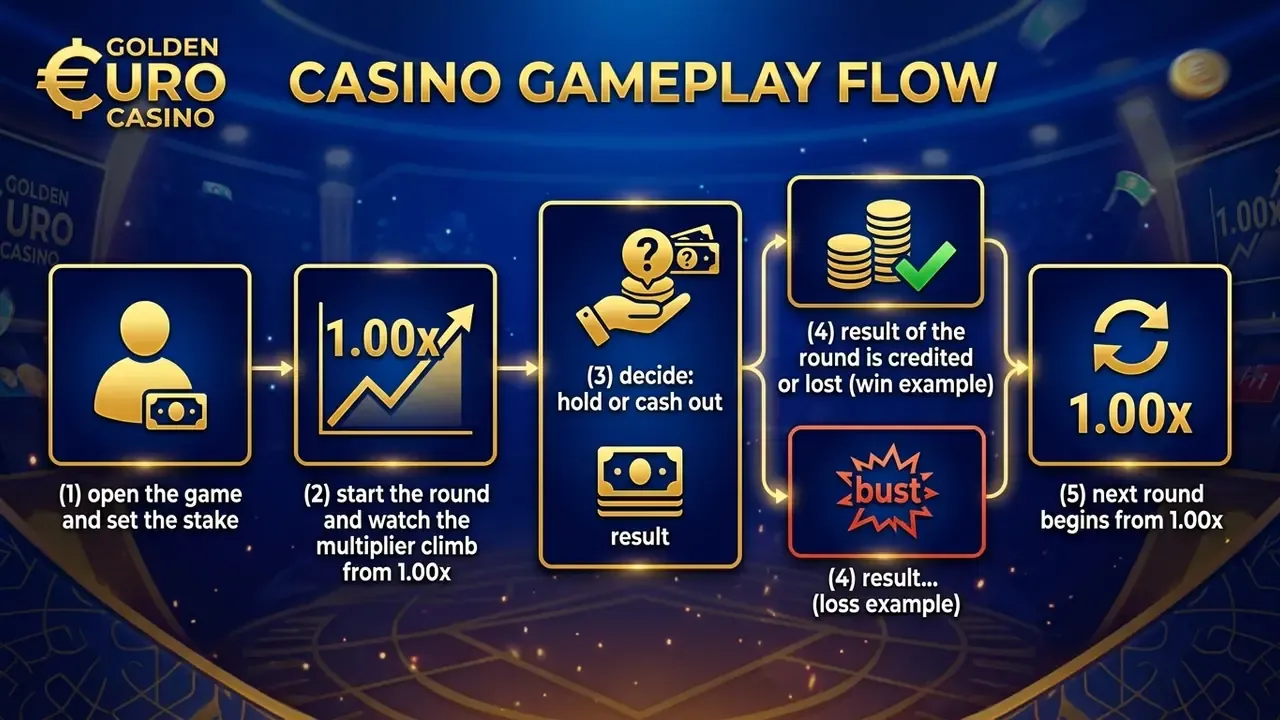
  2. Start the round. The balloon begins inflating and the multiplier climbs from 1.00x.
  3. Hold or release. Holding the button lets the balloon grow; the longer you hold, the higher the multiplier.
  4. Cash out before the burst to receive stake × multiplier.
  5. If the balloon bursts first, the stake is lost in full. The crash point was determined by the RNG before your decision. Your click cannot change it, only capture it or miss it.
  6. Optional automation. Auto cash-out at a preset threshold (commonly 1.4x to 1.6x, or 2.0x, in published player guides) and auto-bet remove the reaction-time variable.

That fifth point is the one most new players resist. The balloon does not "decide" to pop because you got greedy. The number was already written when the round opened.

3.2 The Crash Casino Loop SmartSoft

3.3 The Casual Click Loop (BGaming Balloon Mania)

BGaming's variant replaces the single growing balloon with a screen full of balloons, each labelled with a fixed multiplier and a displayed "Chance to Win" figure:

  • Hover over a balloon to see its multiplier and first-click win probability.
  • Click repeatedly until it bursts and releases coins; a click counter records every attempt per balloon.
  • Two modes: manual (you choose the target) and spins (the button chooses a random balloon).
  • Autoplay lets you pre-select which balloons participate, set stop conditions, and choose the number of rounds.
  • Bigger balloon means bigger risk and bigger reward, with the multiplier ladder running from x1.1 up to x64.

Why the mechanics matter for strategy: in the psychometric task your pattern is the product; in the crash game your timing is the only lever, and it operates inside a fixed negative expectation.

3.3 The Casual Click Loop BGaming

3.4 Balloon Demo and Free Mode: The Short Version

You can play balloon free before you fund anything. Most casinos that carry the SmartSoft Gaming title expose a balloon demo with virtual credits, usually with no registration. The demo runs the same round logic, the same visual pacing, the same auto cash-out panel. What it doesn't run is your nervous system, because nothing real is at stake. There is a longer treatment of balloon free versus balloon real money further down, including a fact check on what demo mode can and cannot prove.

4. The Mathematics of the Pump: Expected Value and the Break-Even Point

Quick takeaway: Under a uniform belief about the burst threshold, one extra pump is worth more than banking only up to pump 10. After that, expected value turns against you. This single calculation replaces every "gut feeling" heuristic circulating in balloon game guides.

4.1 Setting Up the Uniform Prior

Let M be the maximum number of pumps the balloon can take. If you knew M exactly, the optimal play is trivial: pump to M − 1 and bank. You do not know M, so you begin with a prior belief. A natural starting assumption: M is uniformly distributed on the integers up to 21, that is, M ~ Uniform(1, 21), so any threshold below the ceiling is equally likely.

4.2 Working Backwards From the Ceiling

Suppose you have already pumped 20 times. Every possibility M < 20 has been eliminated, and the two remaining cases are equally likely:

P(M = 20) = P(M = 21) = 1/2

  • Expected value of banking = 20
  • Expected value of pumping = P(M = 20) × 0 + P(M = 21) × 21 ≈ 10.5

Pumping is clearly worse. Now step back to 19 pumps. The probability the balloon bursts on the next attempt is 1/3, so:

E(pump) = (2/3) × 19 ≈ 12.67 versus banking 19, still not worth it.

4.3 The General Formula

Generalising: after i successful pumps, the chance of bursting on the next attempt is 1 / (21 − i). Assuming you would bank immediately after one more successful pump, the expected value of pumping is:

$$\mathbb{E}(\text{pump}) = \frac{20 - i}{21 - i} \cdot (i + 1)$$

Weigh this against the immediate payoff of i (cash out now).

4.4 The Break-Even Point: 10 Pumps

Pumps so far (i)E(pump)Value of cashing out (i)Verdict
5(15/16) × 6 = 5.635Pump
8(12/13) × 9 = 8.318Pump
9(11/12) × 10 = 9.179Pump
10(10/11) × 11 = 10.0010Indifferent, break-even
11(9/10) × 12 = 10.8011Cash out
15(5/6) × 16 = 13.3315Cash out
19(2/3) × 19 = 12.6719Cash out
20(1/2) × 21 = 10.5020Cash out

"From the graph, you can see that the break-even occurs at 10 pumps, as intuitively makes sense. At that point, taking the risk and cashing in has an equal payoff." Gijs Koot, Popping Balloons: Risk Assessment Game, Data Scientist at SpotR.ai (2021).

You can rebuild this in a spreadsheet in about two minutes. Put the pump count 0 to 20 in column A. In column B, compute (20 − A) / (21 − A) × (A + 1), which is the expected value of one more pump. In column C, simply repeat the pump count, which is the value of banking now. Plot both columns as a line chart. The two curves cross at 10, and from that point on the banking line sits permanently above the pumping line. Seeing the crossing point drawn is more persuasive than reading the formula, at least it was for me.

4.5 The Exploration and Exploitation Trade-Off

The single-balloon calculation ignores the hardest part of the real game: you also need information. With 39 rounds (Pymetrics) or 30 balloons (BART), sacrificing the first few balloons to discover where they burst is genuinely profitable, because the knowledge is reused across all remaining rounds. How many you should sacrifice scales with how many balloons remain. With 39 rounds, burning 3 to 5 balloons for calibration costs roughly 10% of your rounds and can improve the remaining 34 substantially. With only 5 rounds left, exploration is pure loss.

Practical translation for the crash casino version: the "prior" is replaced by the published RTP and the crash-point distribution. You cannot learn the crash point of the next round from previous rounds, because rounds are independent. Exploration has zero informational value in a properly implemented RNG crash game, which is precisely why pattern-hunting "prediction systems" for Balloon do not work.

4.5 The Exploration and Exploitation Trade-Off

5. Two Core Strategies: Max Money vs. Max Balloons

Quick takeaway: In the hiring test there is no universally "best" score, only fit with the behavioural profile the employer wants. Choose the aggressive Max Money path or the conservative Max Balloons path before round one, then execute it consistently while still showing learning.

The algorithm behind the Pymetrics Balloon Game scores two traits:

  • Risk-taking: how much you pump before banking. Collecting all the balloons for tiny sums reads as cautious; bursting many balloons while banking large sums reads as adventurous.
  • Learning: whether your behaviour adapts. The burst patterns are not fully random. Each of the three colours carries a different burst probability, and candidates who notice this and change their pump counts per colour score higher on learning.

If you do not know which profile the role wants, read the job advert, the role description and the employer's stated core values.

The algorithm behind the Pymetrics Balloon

5.1 Strategy 1: Max Money (Aggressive / Adventurous Profile)

Best fit: sales, trading, business development, startups, growth roles, entrepreneurial functions.

PhaseAction
Rounds 1 to 5Deliberately over-pump until each colour bursts. Record the approximate burst threshold per colour.
Rounds 6 to 39Pump to roughly 80% of the observed threshold, one or two clicks short, then bank.
Adjustment ruleAfter each burst, reduce that colour's target by 1 to 2 pumps for the next occurrence.

Target metrics: balloons saved 18 to 19 of 39; final bank $20 to $23.

"You should aim to collect fewer balloons than average, around 18-19 balloons. You should aim to collect more money than average, around $20-$23." Maya Strauss, Psychometric Test Developer, JobTestPrep (2026).

5.2 Strategy 2: Max Balloons (Conservative / Cautious Profile)

Best fit: audit, risk management, compliance, accounting, legal, quality assurance, safety-critical operations.

PhaseAction
Rounds 1 to 10Cash out after 3 to 4 pumps to establish a deliberately low threshold.
Rounds 11 to 39Increase pump counts slowly and steadily, searching for the balance between earnings and preservation.
Adjustment ruleNever exceed the smallest observed burst point for that colour.

Target metrics: balloons saved 30 to 31 of 39; final bank $17 to $18, which is roughly average money with a well above average balloon count.

5.3 Side by Side Comparison

DimensionMax MoneyMax Balloons
Behavioural signalCalculated risk tolerance, upside orientationLoss control, reliability, consistency
Balloons banked18 to 1930 to 31
Money banked$20 to $23$17 to $18
Bursts acceptedMany (20 to 21)Few (8 to 9)
Early roundsIntentional bursts for calibrationFast, safe cash-outs
Learning evidenceDownward correction after each burstGradual upward escalation
Risk if overplayedReads as reckless or impulsiveReads as passive, low-ambition

5.4 Do Not Forget the Learning Signal

Both strategies fail if executed mechanically. The algorithm tracks change over time. A candidate who pumps exactly seven times on every balloon for 39 rounds, regardless of colour or outcome, signals no learning, even with an above-average bank. Two behaviours specifically demonstrate learning:

  1. Colour differentiation. Different average pump counts for the three colours by the second half of the task.
  2. Post-burst correction. A visible reduction in pumps on the next balloon of the same colour after a burst.

Reality check: these strategies are commercially published preparation guidance, not an official Pymetrics rule set. Numeric targets come from a single provider's sample of 500+ test-takers, and Pymetrics or Harver do not publish official scoring bands. Treat the figures as calibration ranges, not guarantees.

5.4 Do Not Forget the Learning

5.5 Does Any of This Transfer to Balloon Strategy in a Casino?

Partly, and the part that transfers is not the part players want. Calibration transfers: pre-commit a target, write it down, follow it. Learning does not transfer, because there is nothing to learn. In the hiring test, colour is a real signal. In the casino version, the previous 50 crash points tell you exactly nothing about the next one. Anyone selling a balloon strategy built on "reading the pattern" is selling you a coin-flip diary.

6. Mathematical and Structural Properties of Crash Balloon Games

Quick takeaway: Crash balloon games are usually mathematically fair in the narrow RNG sense and mathematically hostile in the practical sense. Fairness of the draw and negative expected value coexist without contradiction.

6.1 Multiplier Distributions and Fairness

Crash games, including Balloon, generate a crash point per round from a heavy-tailed distribution. Independent statistical audits of large round samples have found that observed outcomes track the theoretical model closely, indicating that the platform's random number generation and multiplier outcomes were consistent with the stated model.

"Statistically significant deviations from the theoretical distribution were economically negligible; the estimated probability-density exponent was α ≈ 1.98 against a theoretical value of 2.0." Dubach, The Gambling Fairness Paradox (2026).

That α ≈ 1.98 result is the key technical finding: the multiplier distribution behaves as advertised. The distribution being honest, however, says nothing about it being profitable. Under a published RTP of 97%, the house keeps about 3%.

"Crash games advertise RTP of around 97%, yet observed return to players fell below the theoretical figure when players held their bets longer." Scott, Sher & Daigle, Cash or Crash: Return to Player Percentages and Expected Value of Crash Games, Gaming Research & Review Journal (2026).

For Balloon specifically, the RTP window reported across operator and review pages is 95.5% to 98.0%, which translates into a house edge of 2.0% to 4.5% depending on the operator's configuration. Two players on two different online casinos can therefore face materially different long-run outcomes while playing what appears to be the same game. Check the info panel, not the affiliate table.

A frequently quoted industry commentary titled The RTP Trap in Crash Gaming (2024) argues that displayed RTP figures create a false sense of near-parity, because players intuitively read "97%" as "I lose 3% of my money," rather than "I lose 3% of everything I wager, repeatedly." That commentary is not peer-reviewed and should be treated as opinion. The underlying arithmetic, though, is not controversial: the edge applies to turnover, not to deposits.

For Balloon specifically, the RTP window

6.2 Rapid Loss Velocity and Session-Level Risk

Round duration is the most underrated risk parameter in crash games. A slot spin takes a few seconds; a crash round can resolve in under 20 seconds, and autoplay removes even the pause for reflection. Because expected value per round is negative, high round frequency multiplies the loss rate rather than the win rate. Players faced expected losses exceeding 500% of wagered amounts per hour under typical behaviour patterns.

"At roughly 179 rounds per hour and negative expectation, expected losses exceeded 500% of hourly staked amounts under typical player behaviour patterns." Dubach, The Gambling Fairness Paradox (2026).

Read that carefully. The figure is not "you lose 500% of your bankroll," it is a velocity measure: cumulative expected loss relative to a single hour's staking behaviour when stakes are recycled through many rounds. The practical implication is blunt. Capping rounds per session is a stronger protective control than capping stake size.

6.3 Payout Ceilings, Budget Constraints, and Algorithmic Stopping Rules

The advertised maximum multiplier is rarely the effective maximum. Balloon is listed at 10,000x, but the same pages specify a $10,000 cash cap per round, which means a $10 stake can theoretically reach the multiplier ceiling, while a $100 stake hits the cash ceiling at 100x. Additional review pages list 5,000x or 25,000x for different Balloon variants, so the "max win" figure is variant-dependent and operator-dependent.

Behind the scenes, crash engines operate under payout budget constraints. The round continues until either an algorithmic stop is triggered or a maximum multiplier ceiling is reached.

6.3 Payout Ceilings, Budget Constraints, and

"The algorithm tracks the worst-case payout at every multiplier step and terminates the round if the payout budget would be exhausted." Algorithmic Threshold Optimization: Quantitative Modeling of Multiplier Distributions in Crash Games, arXiv (2026).

This is why extremely high multipliers appear less often in live play than a naive reading of the distribution suggests, and why "the balloon always pops right after I raise my stake" is a real structural effect at the extreme tail. At ordinary multipliers, though, it is a bias, plain and simple.

6.4 Provably Fair vs. Certified RNG

Two different verification models are routinely conflated:

ModelWhat it guaranteesVerifiable by the player?
Certified RNGAn accredited laboratory tested the generator and the game's return over a large sampleNo, you trust the certificate
Provably FairEach round's outcome is cryptographically committed in advance and checkable afterwardsYes, per round, by the player

Balloon review pages consistently list "Provably Fair: No", describing certified RNG instead. BGaming states that Balloon Mania uses certified RNG technology, operating under Malta Gaming Authority licence MGA/B2B/785/2020. If per-round verifiability matters to you, check the game's information panel before wagering rather than assuming it.

7. Behavioural Responses to Structural Characteristics

Quick takeaway: How long you play is predicted less by your personality than by the game's design. Event frequency and your biggest single win in the session do most of the work. Knowing which design levers act on you is the first practical defence.

7.1 Structural Characteristics, Event Frequency, and Maximum Wins

Machine-learning analyses of real operator data have modelled session length from game design features rather than self-reported traits. The strongest predictor was event frequency, meaning how many betting events per unit of time the game permits, followed by the maximum amount won on a single bet in the session.

"Structural characteristics and session metrics jointly explained 26% of the variance in the number of games played, with event frequency emerging as the most significant factor." Decision-tree-based machine-learning study of online gambling behaviour (2023).

That maps directly onto crash balloon games. They sit among the highest event-frequency products on the market, and they routinely deliver one large multiplier early in a session, exactly the two features associated with extended play.

Product breadth compounds the effect. Modern platforms do not offer one balloon game; they offer several crash variants alongside dozens of adjacent casino games.

"Contemporary online operators offer around fourteen roulette variants on average; engagement across multiple formats is associated with higher expenditure and harm." Newall et al., Journal of Gambling Issues (2023).

Operators carry around fourteen roulette games on average, and a comparable proliferation now exists in the crash category, where Balloon sits beside aviator-style, mine-style and rocket-style titles sharing the same cash-out logic. Multi-format engagement, not single-game preference, is the pattern associated with elevated spend.

7.2 Within-Session Chasing of Losses and Wins

Chasing is the behavioural core of crash-game harm, and it is asymmetric in time.

"Gamblers increased stakes and extended sessions after immediate losses, whereas accumulated losses were associated with reduced stakes, likely reflecting financial constraint." Within-session chasing of losses and wins in an online eCasino, Scientific Reports (2024).

Gamblers bet more and played longer sessions after immediate losses, which is classic loss-chasing. Note the nuance: the escalation is driven by the most recent outcome, not the session total. A player who is down 40% overall but just lost a single round is the player most likely to raise the next stake. Crash games amplify this because the loss signal, a bursting balloon, is visually dramatic, immediate, and repeats every few seconds.

Win-chasing exists too. A large multiplier early in the session frequently produces higher subsequent stakes rather than a cash-out, because the reference point for "normal" winnings has shifted upward.

Gamblers bet more and played longer

7.3 Mandatory Play Breaks and Cooling-Off Effects

Structural interventions work, and their effect size depends on who is being interrupted. In large-scale experiments with Norwegian players, imposing a longer forced pause led to extended self-chosen pauses afterwards.

"Longer mandatory breaks substantially delayed the resumption of play among 'hurried players', precisely the group that otherwise returned to play fastest." Large-scale experimental study of mandatory breaks among Norwegian gamblers (2023).

The practical inference for balloon game players is direct. A forced interruption disproportionately helps the fastest, most compulsive playing style. If your operator offers reality checks, session timers or cooling-off periods, enabling them is not a cosmetic gesture; it targets the exact mechanism (high event frequency plus immediate-loss chasing) that makes crash games costly. In Ontario, licensed sites are required to surface these tools; on offshore sites, you often have to dig for them in account settings.

8. Cognitive Risk-Taking in Balloon-Type Tasks

Quick takeaway: Balloon tasks are not a casino invention. They are a validated laboratory instrument, and clinical research using them reveals measurable differences in how at-risk gamblers process risk. The most diagnostic signal is not how much you pump, but how erratically you pump.

8.1 Abnormal Exploratory Tendencies in Gambling Disorder

The BART has been used extensively to compare people with gambling disorder (GD) against controls, with GD participants demonstrating poorer risk decision-making and higher exploratory tendencies.

"The standard deviation of pumps on unexploded balloons fully mediated the relationship between gambling-disorder group membership and total earnings." BART study in gambling disorder (2024).

This mediation result is the mechanistic heart of the finding. What separated the groups was not average aggressiveness but inconsistency: erratic, poorly calibrated pump counts. In behavioural terms, that is a failure to convert experience into a stable decision rule, the same failure the Pymetrics "learning" dimension is designed to detect, and the same failure that turns a crash-game session into a sequence of improvised, emotionally driven cash-out decisions.

8.2 Diminishing Loss Sensitivity and Loss Aversion

Hierarchical Bayesian modelling of BART data has separated two parameters that intuition tends to merge: how much a loss hurts, and how quickly that hurt fades as losses accumulate.

"Participants with gambling disorder showed higher loss aversion (η² = 0.325) but faster diminishing sensitivity to losses as potential losses accumulated (η² = 0.152)." Hierarchical Bayesian modelling of BART data in gambling disorder (2024).

The combination is counter-intuitive and clinically important. GD participants cared more about losses in the abstract, yet their sensitivity eroded faster in practice, potentially leading to escalating risk-taking once a certain threshold of loss exposure is passed. This is the cognitive engine behind the "one more round" spiral: the first $20 lost feels significant, the fifth $20 feels like nothing at all.

8.3 Neuroimaging and Task Adaptations

Adaptations of the BART for functional imaging settings have confirmed that each pump increases both reward and burst risk, and that cashing out transfers earned tokens into a permanent bank. That makes the cash-out moment the precise behavioural event where the reward-risk trade-off is resolved (Frontiers in Neuroscience, 2023, "Adaptations of the balloon analog risk task for neuroimaging settings: a systematic review"). Methodological reviews from the same literature add two cautions: early pumps are weakly diagnostic of risk propensity, and changing the task's threshold design changes the behaviour observed. In other words, a balloon task measures risk-taking within the rules you were given, which is exactly why casino balloon games, with unlimited rounds and real money, elicit behaviour that laboratory versions never see.

Behavioural profiles also generalise beyond the screen. In one BART study, participants whose task behaviour was risk-taking were more likely to choose the riskier option in a separate one-time monetary decision (Robles et al., "Patterns of Responding on a Balloon Analogue Task," 2014). And in real gambling markets, a 2024 study of in-play sports-betting cash-outs found the dominant stated motivations were cutting losses and accessing money immediately, evidence that cash-out timing functions psychologically as a loss-control device, not a profit-maximising one (PubMed, 2024).

8.3 Neuroimaging and Task Adaptations. Adaptations

9. Balloon Demo, Free Mode, and Balloon Real Money Play

Quick takeaway: Demo mode reproduces the interface and round logic but cannot reproduce the psychology of real loss, and the payout configuration may differ by operator. Treat free play as interface training, not as evidence that a strategy works.

9.1 Balloon Free and Play Demo: What It Does and Does Not Prove

Free-play Balloon runs on virtual credits with no deposit, no withdrawal, and no real payouts. Operator and review pages describe it as "play for fun," typically with no registration required, and state that it uses the same engine, round logic and RNG as the live game. Demo balances are either fixed or refillable depending on the site.

What balloon demo genuinely provides:

  • Familiarity with the interface, buttons and auto cash-out controls
  • A feel for round pacing and multiplier volatility
  • A safe place to test whether your intended cash-out threshold is executable at speed

What it does not provide:

  • Proof of identical payout behaviour. Third-party reviews assert that demo and cash modes share RNG logic, but the same pages state that RTP is operator-configurable (95.5% to 98.0%). Identity of the math engine is asserted; identity of the payout setting is not proven by any primary provider document we could locate.
  • Realistic behavioural data about yourself. Loss aversion, chasing and diminishing loss sensitivity require actual money to activate. A disciplined demo session predicts very little about a funded one.
  • A validated strategy. A winning demo run is a sample of a negative-EV process, not evidence of an edge.

Fact check: balloon free vs. balloon demo vs. balloon real money. Three labels, two real states. "Free" and "demo" describe the same thing in practice: virtual credits, no cashier involvement, winnings that cannot be withdrawn and often cannot even be tracked between sessions. "Real money" means your funded balance in CAD, subject to KYC, wagering terms if a bonus is attached, and withdrawal limits. If a page promises that demo results "convert" once you register, that is a marketing claim, not a game rule. Verified in the game rules panel and the operator's terms: no data supporting conversion.

On the "free-to-paid migration" statistic. An older longitudinal figure often cited here reported that approximately 26% of social casino gamers who had never gambled online migrated to online gambling over six months. Updated caveat: that finding dates from roughly 2016 to 2017, predating the crash-game category entirely, and predating mobile-first product design and modern app-store rules. Read it as historical directional evidence that free play functions as an on-ramp, not as a current estimate for Balloon or any 2026 crash product. Contemporary replication data specific to crash games is, to our knowledge, not yet available.

9.1 Balloon Free and Play Demo

9.2 Play for Real: Conditions and Checks

Before funding an account, verify the licensing status of the online casino offering Balloon and confirm that it operates under a jurisdiction with recognised consumer protections. Practical experience from our own iGaming coverage shows that most player disputes trace back to two things checked after depositing rather than before: verification requirements and withdrawal terms.

Regulatory baselines worth knowing (UK Gambling Commission framework, applicable in spirit to most tier-one jurisdictions, and broadly mirrored by AGCO standards in Ontario):

RequirementWhat the regulator expectsWhy it protects you
Identity verification before gamblingOperators must obtain and verify name, address and date of birth before the customer gamblesPrevents "verify at withdrawal" traps
No maximum withdrawal cap on deposit balancePlayers must be able to withdraw funds from their deposit balance, including winnings, at any timeStops artificial drip-feeding of payouts
Pre-deposit disclosure of KYC documentsOperators must tell customers before deposit which documents may be required and whenRemoves surprise document demands

One more Canadian-specific check: confirm that Interac e-Transfer is available for withdrawals, not only deposits. Plenty of sites accept Interac in and pay out only by crypto or bank wire, which quietly adds days and fees.

9.3 Demo to Real Transition Checklist

  1. Licence verified. Regulator name, licence number, and the licence-holding legal entity, cross-checked on the regulator's own register rather than the casino's footer.
  2. KYC completed before first wager. Upload documents proactively; do not wait for a withdrawal request.
  3. Withdrawal terms read in full. Look specifically for maximum withdrawal limits, pending periods, and any bonus-linked cap on winnings.
  4. Game info panel checked. Confirm the operator's actual RTP setting for Balloon (95.5% and 98.0% are very different products), the max multiplier, and any per-round cash cap.
  5. Deposit limit set. A hard monthly limit set on day one, before the first loss, is worth more than any strategy in this article.
  6. Loss limit and session timer enabled. Given that event frequency is the dominant predictor of extended play, session controls address the actual risk driver.
  7. Reality checks on. Periodic pop-ups counteract time distortion in high-frequency games.
  8. Stake sizing decided in advance. A fixed unit, commonly 0.5% to 2% of session budget per round in published player guides, removes in-the-moment escalation.
  9. Payment method traceable and personal. No shared cards, no third-party wallets, and the account name must match your ID.
  10. Self-exclusion route identified. Know where the button is before you need it.
9.3 Demo to Real Transition Checklist

10. Balloon Online and Balloon Mobile: Browser, App, APK, PWA

Quick takeaway: Balloon runs in any modern HTML5 browser on desktop and mobile with no installation required. Downloadable clients are operator distribution channels, not technically superior versions of the game. The safety difference between channels is larger than the performance difference.

10.1 Desktop and Browser Access

Balloon is documented as running in HTML5 browser mode across Windows, macOS and Linux, in Chrome, Firefox, Safari and Edge, with no third-party software needed. Nothing in the retrieved technical material indicates a functional advantage for a native client over browser play. Browser access is also the easiest channel on which to verify the operator's licence, because the licence footer and regulator links sit on the same page you are playing from.

10.2 Balloon Mobile Play and Balloon Download Safety

Mobile access splits into three routes:

Access routeRequirementsDemo availableStart speedControl comfortRisk notes
Mobile browser (HTML5)Modern iOS/Android browserYes, per operatorImmediate, no installTouch tap or hold; fine for single-button cash-outLowest risk: no sideloading, licence visible
Official app (App Store / Google Play)Store availability in your provinceVariesFast after installNative gestures, smooth controls per store listingsStore review adds a verification layer
APK / sideloaded client (Android)Manual install, security settings changedUnclearMarketing pages claim faster than browserSimilar to appHighest risk: unverified binaries, no store vetting

In plain text, so the table is not the only source: browser play on a phone needs nothing but a current version of Chrome or Safari, and it keeps the balloon demo one tap away. An official store app installs faster access and native gestures, and the store listing itself is a small trust signal. A sideloaded APK from a casino landing page gives you no verification whatsoever, which is why it is the one route worth refusing.

Two technical clarifications, because vendor pages blur them:

  • An APK is not automatically a native app. Google's own developer documentation on adding a Progressive Web App to Google Play (2024) shows that a PWA can be packaged into an Android app bundle or APK via Bubblewrap, meaning many "apps" are wrappers around the same web game you can open in a browser.
  • PWA installation on Android may produce a WebAPK, a shortcut, or a QuickApp (web.dev, "Installation," 2024), so "installing the app" often changes nothing about the game engine, only about the launch icon.

Speed and control claims found on promotional casino pages are not backed by primary technical documentation and conflict in detail; treat them as marketing. For the desktop side, the only concrete client documentation retrieved describes a Windows/macOS/Linux desktop client that requires a running server, an architecture unrelated to casino balloon products.

Safety guidance for balloon mobile play: prefer the mobile browser or an official store app; avoid sideloaded APKs from casino landing pages; never install a "Balloon predictor" or "signals" application, because no such tool can predict an RNG crash point. If an app asks for SMS or contacts permissions to run a balloon game, close it.

In plain text, so the table

11. Balloon Strategy, Risk Management, and Bankroll Discipline

Quick takeaway: Strategy in Balloon controls variance, never expectation. The only decisions with a proven long-run effect on your balance are how much you stake, how many rounds you play, and when you stop.

11.1 Important: Strategy Does Not Eliminate Risk

Disclaimer: This information is general in nature and does not replace consultation with a qualified specialist. Gambling involves a risk of financial loss; if you notice signs of problem behaviour, seek professional help.

Three facts settle the strategy question:

  1. Each round is resolved by a randomly determined crash point. Your only control is when to cash out, not what the outcome is.
  2. Published RTP of 95.5% to 98.0% implies a house edge of 2.0% to 4.5%, applied to every dollar wagered, cumulatively.
  3. Prediction systems and "guaranteed winning methods" for Balloon do not work and are explicitly described as non-functional in the reviewed material.

There is no cash-out threshold, betting pattern, martingale, anti-martingale or "signal" that converts a negative-EV game into a positive one. What strategy can do is shape the distribution of outcomes: a low fixed auto cash-out (say 1.4x to 1.6x) produces frequent small wins and a slow bleed; a high target (10x or more) produces rare large wins and long dry spells. Both carry the same negative expectation.

Three facts settle the strategy question

11.2 Cash-Out Thresholds: What Changes and What Does Not

Auto cash-out targetHit frequencyVarianceLong-run expectation
1.2x to 1.4xVery highVery lowNegative (house edge)
1.5x to 2.0xHighLow to moderateNegative (house edge)
3x to 5xModerateHighNegative (house edge)
10x to 100xLowVery highNegative (house edge)
1,000x and aboveExtremely lowExtreme; capped by payout ceilingNegative (house edge)

Published player guides converge on fixed-stake budgeting, low-percentage session sizing, preset cash-out targets, and auto cash-out thresholds around 1.4x to 1.6x or 2x, mostly because those settings feel controllable and reduce the impact of reaction-time error. They remain commercial guidance, not evidence of an edge.

11.3 Bankroll Rules That Actually Bind

  1. Set the session budget before opening the game, in money you have already decided to lose.
  2. Fix the unit stake at a small percentage of that budget (0.5% to 2% is the commonly published range), and never scale it up mid-session.
  3. Cap the number of rounds, not just the money. Given that event frequency predicts extended play, a round cap is the more effective lever.
  4. Use auto cash-out to remove emotional decision-making at the moment the balloon is largest.
  5. Never raise stakes after a loss. This is the single behaviour most consistently linked to harm in within-session chasing research.
  6. Take mandatory breaks. Forced pauses measurably delay resumption of play, most strongly among the fastest players.
  7. Treat a big win as the end of the session, not the start of a bigger one. Maximum single-bet win is a documented predictor of longer play.
  8. Track a written log of deposits and withdrawals across a month. Memory systematically under-reports losses. Everyone remembers the 40x cash-out; nobody remembers the ninety rounds that paid for it.
11.3 Bankroll Rules That Actually Bind

11.4 Psychotype and Cash-Out Timing

Cash-out timing is where personality and mathematics intersect. Research on in-play cash-outs shows the behaviour is used primarily to cut losses and to access money immediately, that is, as loss control. Meanwhile, BART evidence shows that erratic pump variance, not high average pumps, is what distinguishes at-risk profiles. Combine the two and a useful self-diagnostic emerges:

  • Consistent, pre-committed cash-outs: controlled play, variance managed, losses bounded by budget.
  • Variable, mood-dependent cash-outs: the pattern statistically associated with poorer outcomes, regardless of the average multiplier you target.

If your cash-out point drifts upward after wins and after losses alike, the game is setting your thresholds, not you.

11.4 Psychotype and Cash-Out Timing. Cash-out

  1. FAQ: Balloon Game Max Win, Fairness and Safe Play Online

Is it safe to use one strategy for all 39 rounds of the hiring test?

No. The algorithm explicitly tracks a learning factor. If you do not change your pump count after a balloon of a given colour bursts, the system will lower your score on learning ability, even if your final money total looks strong. Vary behaviour deliberately and consistently with observed evidence.

What is a good score in the Pymetrics Balloon Game?

There is no official scoring band, because "good" is relative to the role's target profile. As calibration: the average test-taker banks 24 to 25 of 39 balloons and about $18, finishing in roughly 4 minutes. Adventurous profiles aim for 18 to 19 balloons and $20 to $23; cautious profiles aim for 30 to 31 balloons and $17 to $18.

What is the maximum win in the casino Balloon game?

Reported figures are inconsistent by provider, variant and operator. SmartSoft Gaming pages list 10,000x with a $10,000 per-round cash cap; other pages list 5,000x or 25,000x. BGaming's Balloon Mania has a default max of x64 and a €256,000 maximum win. Always read the in-game paytable rather than an affiliate page.

Is Balloon provably fair?

Review pages for Balloon list "Provably Fair: No" and describe certified RNG instead. Certified RNG means an accredited laboratory tested the generator; provably fair means you can verify each individual round cryptographically. These are different guarantees, so check which one your operator actually offers.

What is Balloon's RTP and volatility?

RTP is reported at 95.5% to 98.0%, with 96% as a common default, so the house edge is 2.0% to 4.5%. Volatility is usually described as high, though some sources note that SmartSoft Gaming does not publish a fixed volatility rating, because the player's cash-out timing largely determines the risk profile. BGaming's Balloon Mania is by contrast explicitly low volatility at 97% RTP with a 1.13 hit rate.

Do balloon demo and balloon real money use the same math?

Third-party reviews say the engine and RNG logic are the same. However, the same sources state RTP is operator-configurable, so payout settings can differ between casinos, and no official provider document confirming identical payout behaviour across modes was found. Practically: play demo to learn the interface; it does not certify the paytable you will face when you play for real.

Do I need a balloon download to play?

No. Browser (HTML5) play requires no installation on desktop or mobile. Android APK files and store apps are distribution channels; a Google Play "app" may simply be a packaged PWA wrapper around the same web build. If you prefer an icon on your home screen, use the browser's own "add to home screen" option.

Can any balloon strategy beat the game?

No. Every round's crash point is randomly determined and independent of previous rounds, and the RTP is below 100%. Strategy alters variance and session length; it cannot alter expectation. Any product claiming to predict crash points is not credible, and paying for one is a second loss on top of the first.

Is Balloon Game safe to play online in Canada?

The game can be safe in the technical sense: certified RNG, licensed supplier, published RTP. The activity carries real risk. A four-wave longitudinal study of the colliding harms of gambling and gaming (2023 to 2024) found online casino play to be the format most strongly associated with problem outcomes, with odds ratios of 4.32 for at-risk gambling and 3.14 for at-risk gaming in population-averaged models (p < .001).

Play only on licensed platforms, only with money you have already written off, with deposit limits and session controls enabled from the first day. In Ontario, prefer AGCO-licensed sites; elsewhere, check your provincial operator first.

Disclaimer: This information is general in nature and does not replace consultation with a specialist in problem gambling.

Appendix A: Glossary of Key Terms

TermMeaningWhy it matters in Balloon
BARTBalloon Analogue Risk Task, a validated laboratory measure of risk propensityThe scientific ancestor of both the HR test and the casino game
Uniform PriorA belief state in which every possible burst threshold is equally likelyThe assumption that yields the 10-pump break-even point
Expected value E(pump)(20 − i)/(21 − i) × (i + 1) under a uniform priorTells you when one more pump stops being rational
Break-even pointPump 10, where E(pump) equals the value of cashing outThe mathematical boundary between calculated and reckless
Risk-takingHow far you push before bankingOne of two traits scored by the Pymetrics balloon game
Learning abilityWhether your behaviour adapts to observed burst patternsThe trait most candidates fail by playing mechanically
RTPReturn to player over a large sample (95.5% to 98.0% for Balloon)Defines the unavoidable house edge of 2.0% to 4.5%
Hit rateAverage number of events per win (1.13 in Balloon Mania)Indicates how often, not how much, you win
VolatilityDispersion of outcomes around the RTPHigh in crash Balloon, low in Balloon Mania
Event frequencyBetting events permitted per unit timeThe strongest documented predictor of extended play
Loss chasingIncreasing stakes after an immediate lossThe behaviour most consistently linked to harm
Diminishing loss sensitivityLosses hurting less as they accumulate (η² = 0.152 in GD samples)The cognitive engine of "one more round"
Certified RNGLab-tested random number generatorWhat Balloon offers
Provably FairPer-round cryptographic verifiability by the playerWhat Balloon is reported not to offer
Payout ceilingHard cash cap per round (for example $10,000)Can bind before the advertised 10,000x multiplier
KYCKnow Your Customer verificationMust be completed before gambling under UKGC and AGCO-style rules
Interac e-TransferCanada's dominant bank-to-bank payment railThe practical test of whether a balloon casino pays Canadians quickly

Appendix B: Pre-Play Checklist

If you are taking the hiring test:

  • Identified the target profile (adventurous vs. cautious) from the job advert and employer values
  • Chosen Max Money (18 to 19 balloons, $20 to $23) or Max Balloons (30 to 31 balloons, $17 to $18)
  • Planned the calibration phase: rounds 1 to 5 over-pumping, or rounds 1 to 10 fast cash-outs
  • Committed to tracking the three balloon colours separately
  • Committed to reducing pumps on a colour after each burst (learning signal)
  • Accepted that ~4 minutes and 39 rounds are the expected format
  • Practised at least one full simulated run before the live attempt

If you are playing the casino version:

  • Regulator, licence number and legal entity verified on the regulator's register
  • Legal to play from your province, and you meet the 19+ (or 18+) age rule
  • Operator's actual RTP setting for Balloon confirmed in the game info panel
  • Max multiplier and per-round cash cap noted
  • CAD accounts supported, and Interac or e-wallet available for withdrawals
  • KYC completed before the first wager
  • Withdrawal terms read, with no maximum withdrawal cap on deposit balance
  • Deposit limit, loss limit and session timer enabled
  • Reality checks switched on
  • Fixed unit stake defined (0.5% to 2% of session budget)
  • Round cap set, not only a money cap
  • Auto cash-out configured, so the decision is made before the balloon grows
  • Rule accepted in advance: no stake increase after a loss
  • Self-exclusion route located
  • Playing in browser or an official store app, with no sideloaded APKs and no "predictor" tools
Appendix B Pre-Play Checklist. If you

A Calm Word Before You Play

Balloon is a fast, well-made game with an honest distribution and a permanent negative edge. Both halves of that sentence are true at once. If you want to see it, open the balloon demo, set an auto cash-out at 1.5x, and watch a hundred rounds without touching anything. That is the game. Everything else is decoration.

So: compare on the facts, read the terms line by line before you deposit, set your limits first, and treat any session budget as the price of entertainment rather than an investment. If play stops feeling like a choice, support in Canada is free and confidential through ConnexOntario (1-866-531-2600) in Ontario, GameSense in British Columbia, and provincial help lines elsewhere.

Sources referenced in this guide: Dubach, The Gambling Fairness Paradox (2026); Scott, Sher & Daigle, Cash or Crash: Return to Player Percentages and Expected Value of Crash Games, Gaming Research & Review Journal (2026); Algorithmic Threshold Optimization: Quantitative Modeling of Multiplier Distributions in Crash Games, arXiv (2026); Within-session chasing of losses and wins in an online eCasino, Scientific Reports (2024); Newall et al., Journal of Gambling Issues (2023); decision-tree machine-learning study of structural characteristics and session length (2023); large-scale experimental study of mandatory breaks among Norwegian gamblers (2023); BART studies in gambling disorder, including hierarchical Bayesian modelling (2024); Frontiers in Neuroscience systematic review of BART neuroimaging adaptations (2023); Robles et al., Patterns of Responding on a Balloon Analogue Task (2014); PubMed study on cash-outs during in-play sports betting (2024); longitudinal study on the colliding harms of gambling and gaming (2023 to 2024); Gijs Koot, Popping Balloons: Risk Assessment Game (2021); JobTestPrep, The Pymetrics Balloon Game: Strategy and Guide (2026); BGaming Balloon Mania game specification, MGA/B2B/785/2020; UK Gambling Commission requirements on identity verification and withdrawals; AGCO and iGaming Ontario player-protection standards; Google Developers, Adding Your Progressive Web App to Google Play (2024); web.dev, Installation (2024).

19+ in most Canadian provinces (18+ in Alberta, Manitoba and Quebec). Please play responsibly.

A Calm Word Before You Play